Svařák, trdelník and Christmas food in Prague
Every market in Prague pours much the same hot drinks and cooks much the same short list of dishes. What changes your evening is knowing what to order and where visitors tend to overpay. This guide goes stall by stall through the drinks and the food and tells the real story of the chimney cake. It ends with what Czech families eat at home on Christmas Eve.
Svařák, medovina, grog or punč
Almost every drinks hut in Prague chalks up the same short menu. Svařák is the Czech take on mulled wine, heated with sugar and spices. Most stalls sell it in red and in white, and the white is the lighter of the two on a long evening. Medovina is hot mead, a honey wine warmed until it steams. It goes down like dessert, which makes it easy to drink faster than you meant to.
Grog is the plainest thing on the board, rum topped up with hot water and a squeeze of lemon. Punč, the Czech word for punch, changes more from one stall to the next than anything else, so ask what goes into it before you pay. If you only try two, start with svařák, the cup locals order without thinking, and finish with a medovina to see whether honey wine is for you.
Alcohol-free cups and the deposit
Hot chocolate is a standard on the boards, and the stalls also sell an alcohol-free punch made for children, which adults order too when they want a break between stronger cups.
The markets serve drinks in returnable or recycled cups instead of throwaway ones. With your first drink you pay a small deposit on the cup. Hand it back at a drinks stall or a cup return hut to get the deposit back, or keep the cup and count the deposit as its price. A drink costs a few dollars' worth of koruna. Cards are widely taken, but carry coins and small notes for the smaller stalls, and when a card reader asks which currency to use, pick koruna rather than your own.
The Prague ham trick
A whole Prague ham turning on a spit over the coals is the smell that greets you on Old Town Square, and it is behind many of the complaints you read about the markets. The figure on the board is the price per 100 g (3.5 oz), not per portion. A vendor carves a generous slab, drops it on the scale, and the total comes out far higher than the board seemed to promise. Nobody has broken a rule, yet plenty of visitors walk away feeling tricked.
The fix takes ten seconds. Before the knife comes down, say how much you want and ask for the weight and the total. Only then say yes. The other habits of the busiest square in town are in our guide to the Old Town Square market.
Trdelník, a newcomer with an old look
Trdelník is the sweet you see everywhere, dough wound around a spit, turned over heat until golden, then rolled in sugar. Some signs call it a traditional Bohemian treat. It is a recent arrival in Prague rather than an old Czech recipe, so eat it because it is warm and good, not because of the history on the sign.
If you would like to make one, Chimney Cake Workshop Prague runs a 65-minute class from ~$28, about $29 on GetYourGuide, at Lípová 8 in the New Town. You wind the dough onto a wooden spit and coat it, then it bakes while the host talks you through the treat's history, and you eat it warm with the toppings you choose. All ingredients and an apron are included, and reviewers love it, 4.9 from 1,348 on GetYourGuide and 5.0 from 341 on Viator. The catch is how little baking there is to learn. The dough comes ready-made, so you mostly shape and coat a single cake before it goes over the heat.
What else to eat at the stalls
Market food is eaten standing up, cup in the other hand. Look for these.
- Klobása. A thick grilled sausage, the standard supper on a cold evening;
- Bramborák. A potato pancake fried until crisp at the edges;
- Langoš. Fried dough rubbed with garlic, sometimes topped with cheese;
- Oštěpek. A smoked cheese grilled until soft;
- Roasted chestnuts. Sold by the bag, and handy for warming your fingers between markets;
- Perník. Decorated gingerbread that keeps well enough to carry home;
- Fish soup and carp. These appear in the last days before Christmas, a taste of the Christmas Eve table.
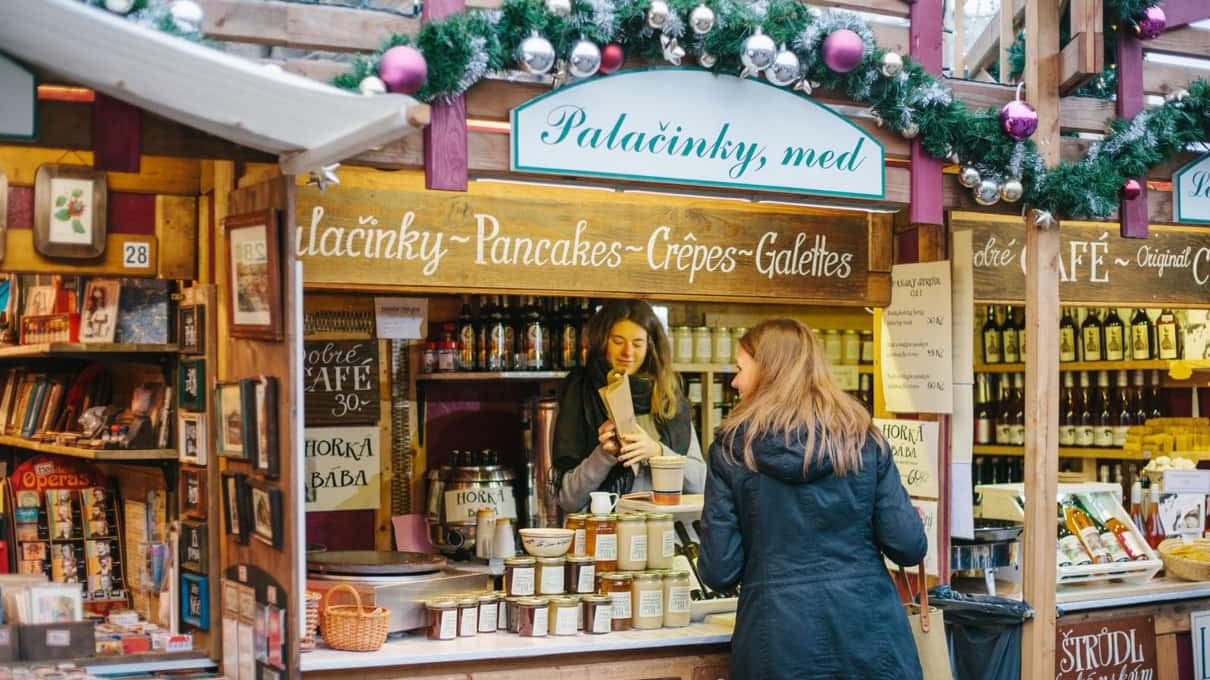
The neighborhood markets cook mostly for residents. Peace Square leans toward organic food, and Tyl Square is where locals go for cheap food and drink. Our guide to the neighborhood markets lists them with their metro stops.
The Christmas Eve table at home
The main Czech feast falls on the evening of 24 December. Families sit down to fish soup and fried carp with potato salad, and only after dinner do they open the presents brought by Ježíšek, the baby Jesus. In the days before, live carp are sold from big tubs on the streets, and some families still keep their fish in the bathtub until the 24th. A few people fast all day in the hope of seeing the golden piglet. Christmas in the Czech Republic has more of these customs.
The baking starts weeks earlier. Households turn out many kinds of small Christmas cookies, called cukroví, with vanilla crescents (vanilkové rohlíčky) as the favorite, and a braided sweet bread called vánočka.
A food tour for a long afternoon
To eat beyond the huts, Taste of Prague's food tour, from ~$169 on Viator, fills about four hours. It meets by the St. Haštal church in the Old Town and moves through several restaurants on foot and by metro, so you also learn how the system works. The tastings add up to a full meal, enough to cancel dinner, and each stop comes with a local drink, with non-alcoholic options. It rates 5.0 from more than 3,800 Viator reviews, and guides such as Jan or Karolina come up again and again. The catch is the price, the highest of any tour we suggest, and the time on your feet. It is not for vegans, and since it is booked weeks ahead on average, December dates go early.
Four hours of Czech food with locals
Taste of Prague takes a small group from the Old Town through several restaurants, with a local drink at each stop, from ~$169. Book once your dates are fixed, and arrive hungry.
A shorter choice for beer drinkers is Eating Europe's food and beer tour, from ~$100, which starts on Anežská street in the Old Town. Over three and a half hours it mixes Czech dishes with sweets such as kolache and apple strudel, stops at Café Louvre and pours craft beer and pilsner. It rates 4.9 from 394 reviews. The catch is that it is sold on GetYourGuide only and the beer leads the way, which makes it a weaker pick for anyone who does not drink.
A warm sit-down supper
After a few hours on your feet in the damp, a table indoors beats another sausage. Walk a few streets off the big squares, where prices fall and the menus are written for locals, and book ahead for Friday and Saturday nights. Shops close around noon on 24 December, most neighborhood markets have ended by then, and some restaurants close for the holidays, so book any Christmas meal early. Old Town Square still trades on the 24th until 2 pm and reopens at noon on the 25th, but organizers publish the final dates and hours only shortly before each season, so look at the market's own page before you rely on it. Our dates and hours guide lists every market's times.
Eat early before a Christmas concert, or warm up over lunch in the Lesser Town after a morning at Prague Castle. With children along, our family guide covers the sweeter end of the menu, and our December weather guide has warm places to wait out the rain.